On this page
- How does the City decide which streets get plowed first?
- When will my residential street be plowed?
- How do Winnipeg’s winter parking bans work?
- Does the City clear the windrow at the end of my driveway?
- Who clears the back lane?
- What about sidewalks and the boulevard?
- Can I push my snow onto the street?
- What if a plow damages my lawn, fence or car?
- How do you plan a winter around the City’s schedule?
- Frequently asked questions
- Before the first big snowfall
The City of Winnipeg plows every public street, sidewalk and back lane, but in a fixed order: regional roads first, then bus routes and collector streets, and residential streets last, usually once about 10 cm has fallen, with the residential operation normally finished within five working days. It also removes driveway windrows taller than 20 cm when it can. What it leaves to you is your driveway and walk, the ridge a back lane or sidewalk plow leaves across your entrance, any pathway you want across the boulevard, and moving your car when a parking ban is called.
Everything below comes from the City’s own published policy and snow pages, with links so you can check each rule yourself. Rules change, so look at the City’s snow page for anything time-sensitive, like whether a ban is on today.
| After a snowfall | Who handles it |
|---|---|
| Regional roads and their sidewalks | City, first |
| Bus routes and collector streets | City, second |
| Residential streets | City, by zone |
| Back lanes, to packed snow | City |
| Driveway windrow over 20 cm left by the street plow | City, if possible |
| Windrow from a lane or sidewalk plow | You |
| Your driveway, walk and steps | You |
| A path across the boulevard | You |
| Moving your car during a ban | You |
How does the City decide which streets get plowed first?
Every street in Winnipeg has a priority, and the priority sets both the order and the trigger. The City’s street priorities sheet lays it out:
- Priority 1: major regional roads and their sidewalks. These are fully plowed within 36 hours once more than 3 cm has accumulated, and they are salted and sanded as needed.
- Priority 2: non-regional bus routes and collector streets. These are fully plowed within 36 hours of more than 5 cm.
- Priority 3: residential streets. One driving lane is opened within 36 hours of more than 3 cm, but the street is only fully plowed when the City calls a residential operation.
That last line is the one that surprises people. After a modest snowfall, a residential street can have one lane cut through it and stay that way for days. The Council policy says residential plowing usually starts after about a 10 cm accumulation, and only after Priority 1 and 2 streets are in satisfactory shape. In January 2025 the Mayor and the chair of Public Works backed a motion to cancel a pilot that would have raised the residential threshold from 10 cm to 15 cm, after residents pushed back on safety and accessibility.
Residential streets are kept to a packed snow surface, not bare pavement, although the policy says they are plowed down to pavement whenever conditions allow during a full operation.
When will my residential street be plowed?
Your street is plowed when your snow zone comes up on the schedule. Every residential street carries a zone letter, and when the City calls a residential parking ban it publishes which zones are plowed on which shift. Zones run in 12-hour shifts, 7 a.m. to 7 p.m. and 7 p.m. to 7 a.m., and the City says a full city-wide operation normally takes about five shifts.
There are three ways to find your zone letter: the free Know Your Zone app, the online address lookup, or a call to 311. The app can also send a push notification when a ban is called for an address you save as a favourite.
A few details from the City’s snow FAQ that are worth knowing before the first big storm:
- Check your zone every fall. The City says it may reconfigure zones, so last year’s letter is not guaranteed.
- The schedule loosely follows garbage day. Residential plowing is generally set by the garbage and recycling collection schedule. When the two land on the same day, crews move the carts and put them back.
- A plow can show up early. If crews get ahead of schedule they may clear the non-parking side of a street, then come back for the parking side on the next shift.
- A heavy storm can take more than one shift. If your zone needs a second pass, crews return after the city-wide operation is finished.
- Rural roads inside city limits have no zone. They are plowed separately, without parking restrictions.
How do Winnipeg’s winter parking bans work?
There are five kinds of winter parking ban, and they do different jobs. The City’s parking ban page describes each one:
- Winter route parking ban. This is the annual one. It can start any time from November 1 to the end of April, with seven days’ notice, and once it is on you cannot park on a designated winter route between 2 a.m. and 7 a.m. Streets signed either WINTER ROUTE or SNOW ROUTE count.
- Extended winter route ban. Called after a big snowfall, it moves the start of the overnight restriction from 2 a.m. back to midnight.
- Residential parking ban. This is the one tied to your zone. Parking on your street is restricted while your zone is being plowed. The fine is $200, or $150 if paid early, and the City uses automated licence plate recognition, so the ticket can arrive in the mail.
- Snow emergency ban. If the Mayor declares a snow emergency, all parking on winter routes is banned. No tickets are issued, but cars are towed out of the plows’ way.
- Temporary no parking. Individual streets that need extra work get posted signs, and cars left there can be ticketed and towed.
One rule makes the residential ban easier to live with: while it is in effect, the City suspends the overnight winter route ban, so you can park on a winter route overnight until the residential ban ends. Rush-hour and loading-zone signs still apply. The City does not put up signs on residential streets for this ban, so the app, the snow map and the email notifications are how you find out.
Does the City clear the windrow at the end of my driveway?
Sometimes. The Council policy says windrows over 20 cm (8 inches) are normally removed from front driveway approaches during the same shift as the street plowing. The FAQ adds “whenever operationally possible”, asks you to wait until the scheduled shift is over before reporting one to 311, and asks that vehicles and other obstructions be kept at least 3 m (9 ft) clear so the equipment can work.
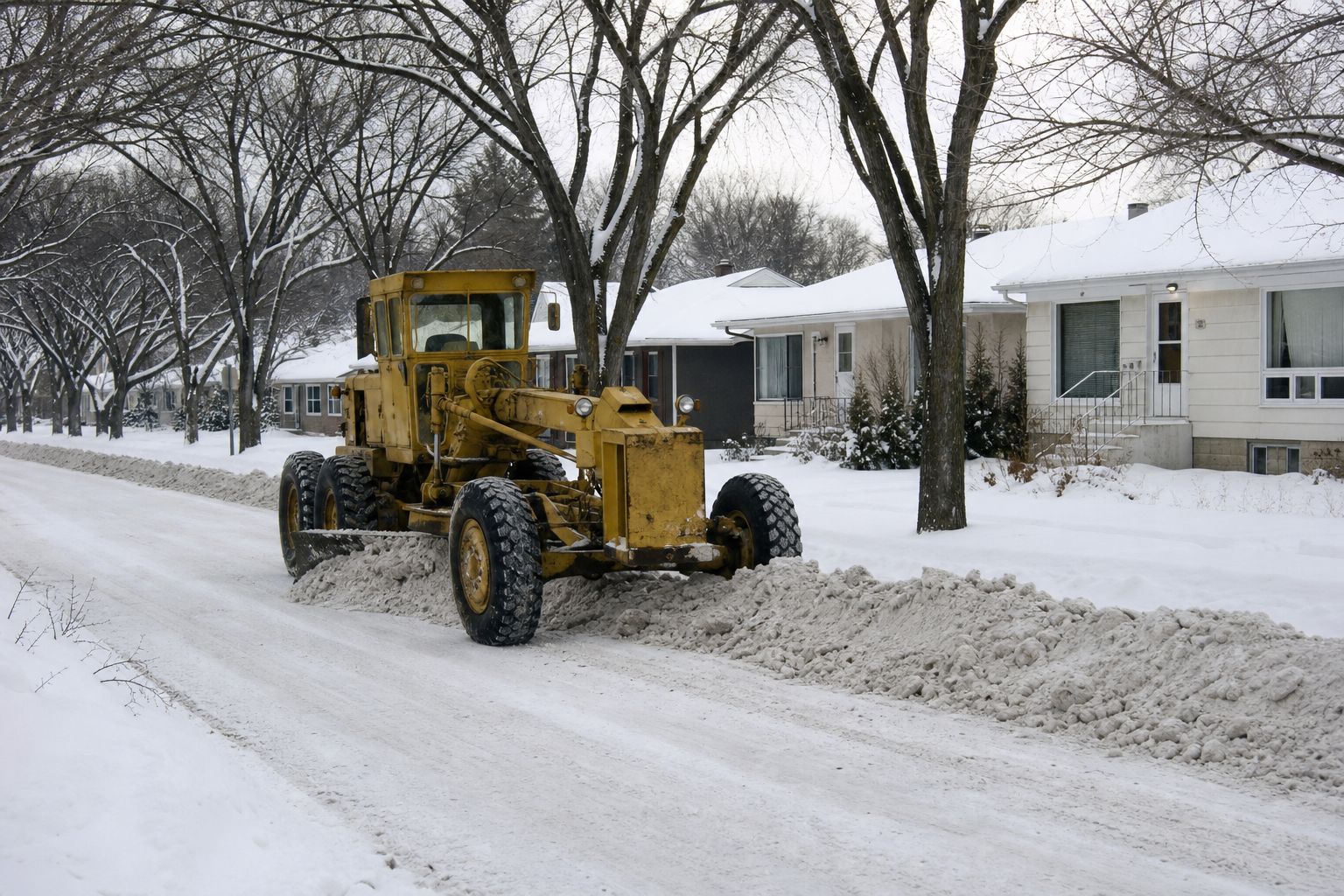
Three kinds of ridge are never on the City’s list. A windrow left by a back lane plow, a windrow pushed across your walk or approach by a sidewalk plow, and a high pile at a private approach are all the owner’s to deal with. The removal rule only covers street windrows over 20 cm, so a lower one is yours too. Our windrow clearing page goes through each case and how we break up a ridge that has already set hard.
Who clears the back lane?
The City plows back lanes, but only down to packed snow, and whatever ridge the lane plow drops over your garage pad or rear gate stays with you. Lanes are cleared after about 5 cm has fallen or drifted, the FAQ gives a target of about three days after an average storm ends, and the work usually happens alongside Priority 1 and 2 streets. In mild spells the City may plow lanes more often to help drainage and cut down rutting.
There is one exception in the policy: properties with no front street access get an enhanced level of lane clearing, and their lane windrows may be removed as part of it. For everyone else, the lane ridge is yours, along with the pad itself. That is the job our back lane and garage pad clearing is built around.
What about sidewalks and the boulevard?
The City plows public sidewalks, and you look after the path from your door to the sidewalk and any path you want across the boulevard. Sidewalks on Priority 1 and 2 streets are plowed first, after about 5 cm, then sidewalks on residential streets, with routes near elementary schools given priority where possible. Outside downtown, sidewalks are kept to compacted snow rather than bare concrete.
The boulevard is where the street plow stores its snow, which the City notes is one of the reasons boulevards exist. If you want a path across it to reach the curb, the FAQ says that is your job.
The City does run a limited boulevard access program that clears a 1.5 m path between the curb and the sidewalk for residents who sign an annual declaration. To qualify, the owner or occupant must be physically unable to shovel (a doctor’s certificate is required for new applicants), no other able-bodied person can live there, and the person must be unable to pay someone else to do it. Short-term injuries do not qualify, and neither do properties with front driveways. Contact 311 for the application. If you do not qualify but still need help, our snow removal for seniors and sidewalk and walkway clearing pages cover what we do.
Can I push my snow onto the street?
No. The City’s FAQ says you cannot move snow from your property onto a City right-of-way, and a bylaw officer can investigate and issue a notice. You also cannot haul snow from one place and dump it on another property, a vacant lot included. If a neighbour is piling snow on your side, the City treats that as a private matter and points people to Mediation Services or a lawyer.
This is why the end of a long winter gets hard on a small lot. The snow from the drive has to go somewhere on your own property, and once the piles are high, hauling it away is the only option left. Our snow hauling page explains when that point arrives.
What if a plow damages my lawn, fence or car?
Report it, and start with your own insurer. The City’s damage claims page asks residents to send vehicle claims to MPI and property damage to their home insurer first. If you are unsure who to contact, you can still notify the City through 311 in writing, by phone, email, mail or fax, as soon as possible.
A claim should include a description of the damage, photos, receipts and estimates, and your reasons for believing the City is responsible. The City often hires private contractors, and if a contractor had control of the location, the City’s adjuster forwards the claim to them and tells you in writing.
How do you plan a winter around the City’s schedule?
Plan around the gaps the City leaves, because those are the parts that block you in. Three common setups show where they fall:
A front driveway on a residential street. After a 10 cm snowfall your street may not be fully plowed for days, and when your zone does come up, the plow pushes a ridge of snow over your driveway entrance. If it is under 20 cm, or the crew could not get to it, it is yours. Here, driveway snow clearing that includes the windrow on every visit saves you a second trip out with the shovel.
A detached garage on a back lane. The lane is plowed within a few days of a storm, but only to packed snow, and the ridge across your pad is never removed by the City. If you use the garage daily, the lane ridge is the first thing to plan for.
A house on a bus route. Priority 2 streets are plowed much sooner, but the sidewalk plow comes through too, and the ridge it pushes across your walk or approach is the owner’s.
The same rules apply in every part of the city, from St. Vital and Transcona to St. James and Charleswood. Some people handle all of this themselves. Others book a seasonal contract so the drive, the walk and the windrow are done after every snowfall without a call, or a per-visit clearing only after the big ones.
Frequently asked questions
What zone am I in, in Winnipeg?
Your zone is a letter assigned to your street, and you can look it up in the Know Your Zone app, through the City’s online address lookup, or by calling 311. Check it again at the start of each winter, because the City may reconfigure zones.
What is a snow windrow?
A windrow is the ridge of snow a snowplow or grader leaves behind, which is the City’s own definition. The ones that matter to homeowners are the ridges left across driveway entrances, walks and garage pads.
How long does it take to plow residential streets in Winnipeg?
The City says a residential plowing operation normally takes about five 12-hour shifts city-wide, and its policy sets a target of five working days from the start of residential plowing. Your own street is done during the shift assigned to your zone.
Where can I park during a residential parking ban?
Off the street, or on a designated winter route overnight. The City suspends the overnight winter route ban while a residential ban is on, so winter routes become extra parking until the residential ban ends. Other signs, like rush-hour restrictions, still apply.
How much is the ticket for parking during a residential ban?
The fine is $200, or $150 if paid early. The City uses automated licence plate recognition, so the ticket may come by mail instead of on your windshield.
How much does it cost to have snow cleared in Winnipeg?
It depends on the size of the drive, whether the windrow and walks are included, and whether you choose a seasonal plan or pay per visit. Our snow removal cost guide lists prices that Winnipeg companies publish and explains what moves a quote up or down.
Before the first big snowfall
Look up your zone, turn on the app notifications, and decide who is clearing the windrow before it freezes. If you would rather hand that part off, residential snow removal in Winnipeg is what we do, from the driveway to the lane.